A private tasting notebook that lives on your phone.
Log whisky, and whatever else is in the glass, the 3DC way: three quick measures, a personal A–F grade, and room for the whole story. Your notebook lives on your phone. No account, no cloud, no tracking.
Now on the App Store. Coming soon to Google Play.
No Google Play? Download the Android app directly (1.0.0, 46.5 MB) · How to install
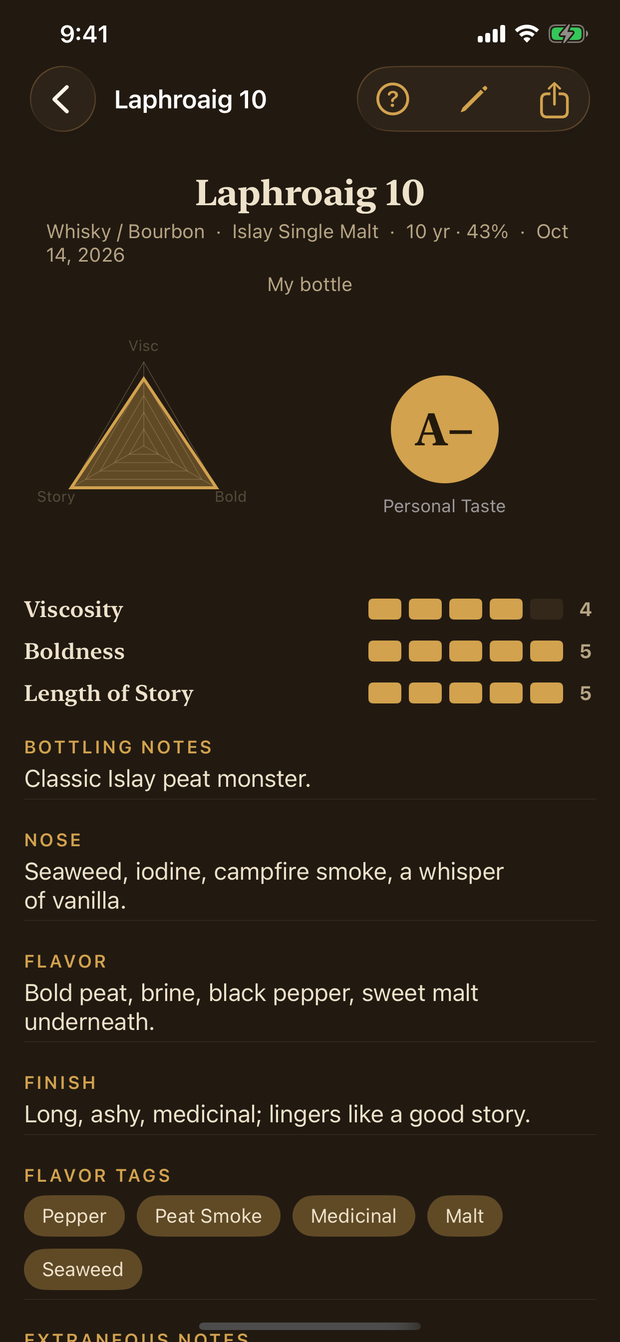
Opaque numbers tell you nothing. 3DC rates a dram four honest ways: three measures anyone can agree on, and one grade that's purely yours.
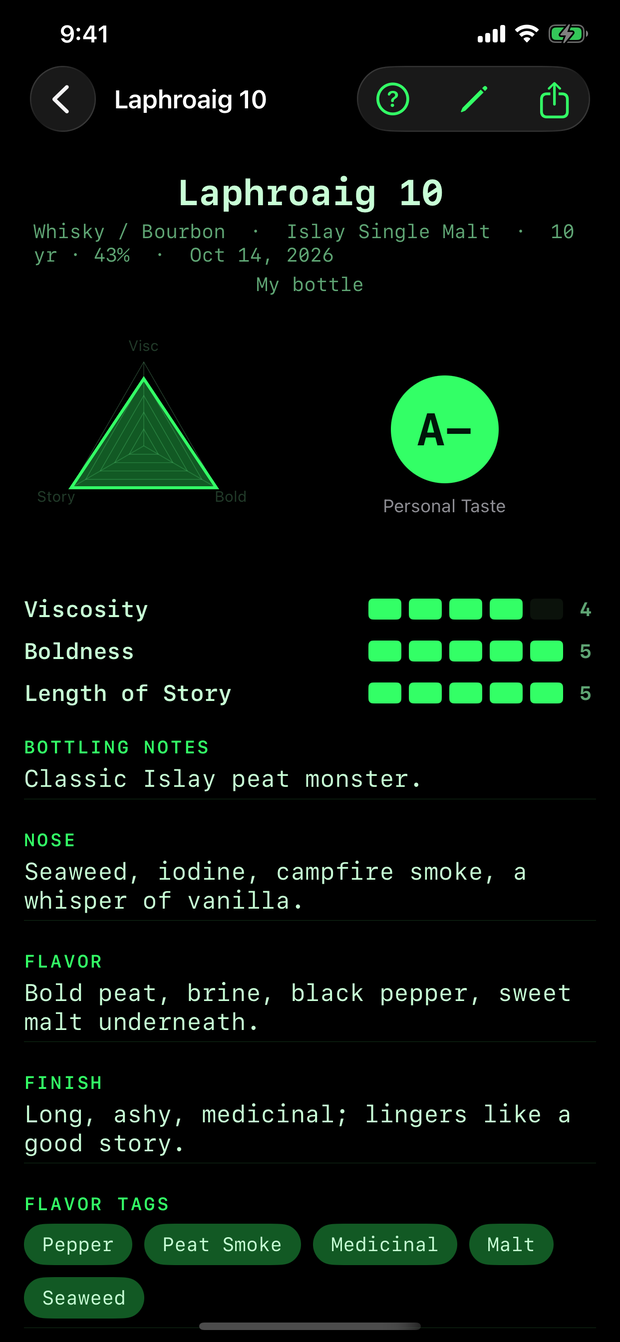
How thick it feels in the mouth. 1 = thin and watery, 5 = thick and syrupy.
How intensely the flavor hits. 1 = gentle and delicate, 5 = intense and assertive.
How long the finish lingers. 1 = short, 5 = a tale that goes on.
Personal Taste: your grade. A letter from A to F (there's no E), fine-tuned with + or −. So B+ beats B beats B−. The three axes are semi-objective; the grade is your verdict, full stop.
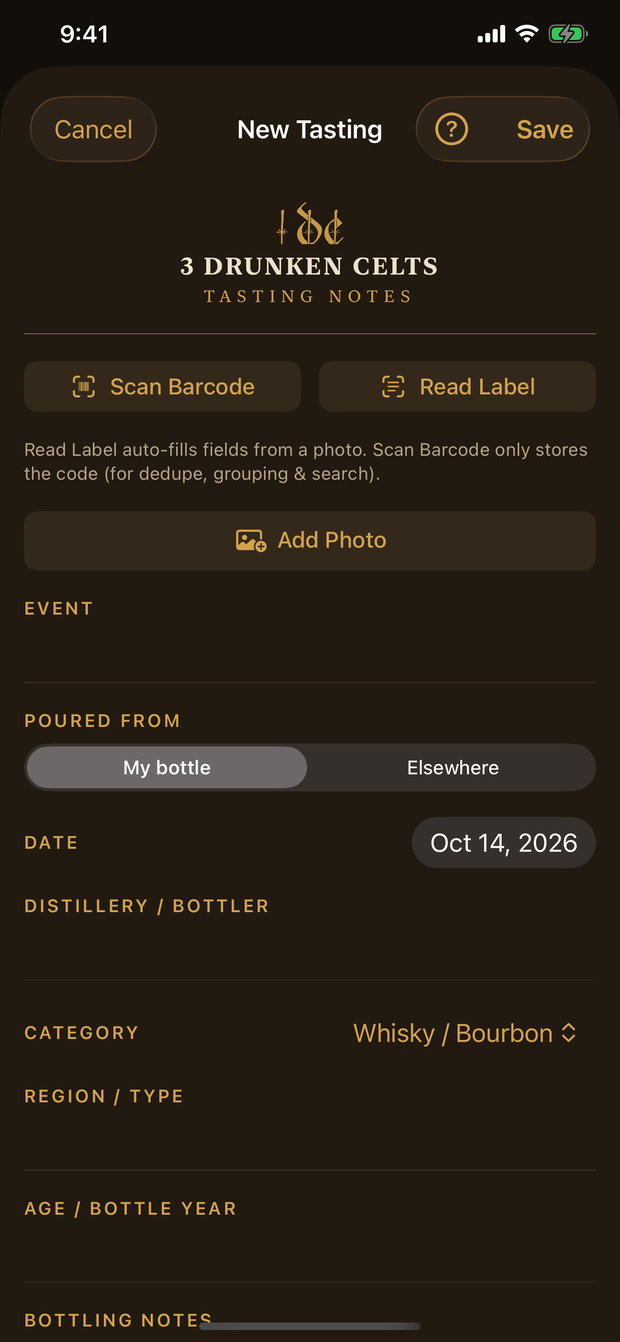
Scan the barcode, let Read Label fill in the maker, age & ABV from a photo of the label, add a picture, and dictate your Nose / Flavor / Finish hands-free.
Tag what you taste from a curated flavor wheel: peat, sherry, vanilla, citrus and more. The app suggests tags from your notes, and every tag is searchable, so "every peated dram" is one tap away.
Search, filter and sort everything you have logged. Mark each pour as your own bottle or poured elsewhere, see re-tastes of the same bottle grouped, and watch fill level, opened date and an "Oxidizing" flag when a bottle's grades start slipping.
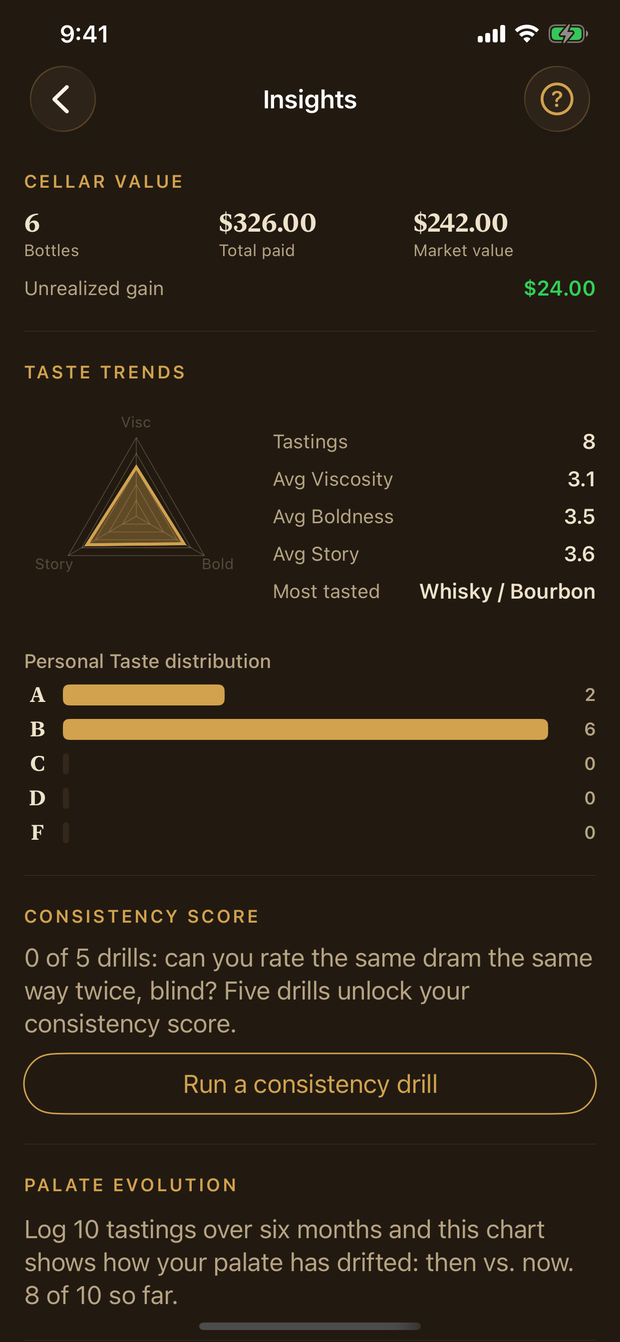
Taste trends, grade distribution, how your palate has drifted, label bias from your blind flights, and a side-by-side compare of any two drams.
Track what you paid against what you reckon your own bottles are worth (you type the numbers; nothing is looked up), each bottle counted once. An opened bottle counts as $0 market value, so gain or loss is figured over sealed bottles only.
Pour into numbered glasses, rate each one blind, then reveal. Pass the phone around for up to eight guests, with an agreement score for every pour and a named contrarian.
Scan a bottle in the shop and see what your own notebook says: have you had it, and how did you grade it? No product database and no sales pitch. Unlocks after five whisky tastings.
Re-taste one of your own bottles blind and see how close you land to your earlier notes. Five drills give you a consistency score.
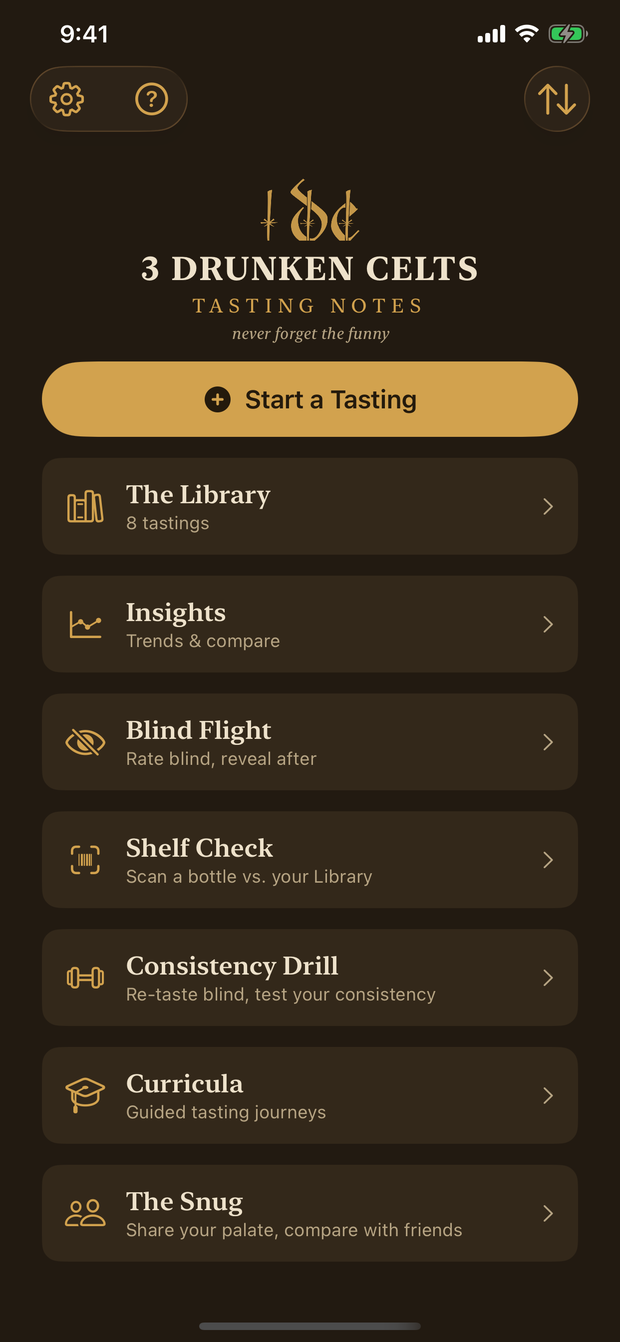
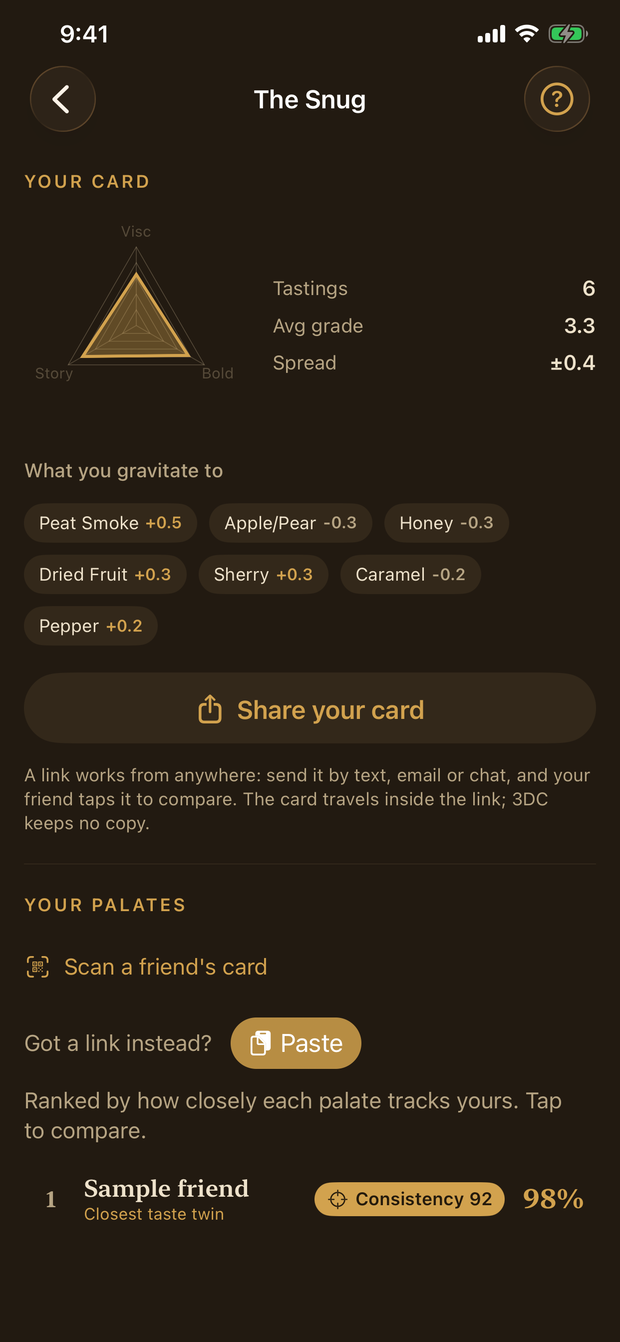
Named for the back room of an old pub: send your palate card to a friend anywhere as a link (or as a QR across the table), find your taste twins, and compare. A friend's newer card replaces their old one. Your own card unlocks after five whisky tastings. No account needed.
Guided tasting journeys like The Peat Ladder name styles to hunt, never brands. Log a match and the step ticks itself off.
Modern, Nostalgic, Natural, Retro, Futuristic, and a Hacker terminal look, each in light and dark.
Your notebook stays on your device unless you share it or back it up. Lock the app with Face ID, Touch ID or your passcode on iPhone, or fingerprint, face or PIN on Android. Back up to a folder you choose, or export JSON and CSV. Photos stay on the phone and aren't included in backups.
No account. No sign-up. No analytics or ads. There's no 3DC server for your notebook: every tasting, note, photo and price lives in the app's private storage on your device. It leaves only when you share something or back it up, and you choose where it goes.
No Google Play? Download the Android app directly (1.0.0, 46.5 MB) · How to install
Google Play is on its way. Until then, the direct download above does the job. Read the Support & User Guide to see everything it does, and the privacy policy for exactly what stays where.
A tasting method born at the table, now in your pocket.
We've made some rather lofty claims on our web site; chief amongst these is “The 3 Drunken Celts are set to change all that you know about whiskies…” Well here's the start of living up to that particular exclamation…
We have a personal beef with how tasting notes and ratings are as currently done by the whiskey world at large. E.g.: what does a “98” rated whiskey taste like? Would it be better on a hot summer afternoon or a cold winter night? Is it thick and warm or thin and refreshing? Is it complex or curt in its story? The “98” really doesn't mean anything to the layman unless you were the one who tasted the dram or at least know what scores in each of the individual categories the reviewer has used which were then added up to the “98” scoring. We are pretty sure the 3 Drunken Celts can do better than that.
We have all found some whiskies that rate highly by the critics, which we personally don't like, while others that do not rate so highly (by the experts at least) are rather enjoyable to us. This is to say that the ratings used by the world at large have seemingly failed us a time or three.
On the most rudimentary level what WE'D like to know about a bottle of whiskey we've never had is: 1. How thick the dram is (Viscosity), 2. How strong the taste is (Boldness), and 3. How long the story is (Length of Story).
Raz finds that he prefers a stronger, thicker dram in the winter and a lighter more complex one in the summer so knowing the viscosity, boldness, and length of story goes a long way towards picking out a dram he may not be familiar with. Additionally, these are categories that can be reviewed with far less subjectivity, thus more easily relied upon by others. In a move towards this objectivity in the ratings, we use a 1–5 scale. For example, if a dram drinks like 10w40 motor oil, as far as “Viscosity” is concerned you'd give it a 5, if thin as water then a rating of 1 would be more appropriate. This same scale will be used for “Boldness” and “Length of Story.” From there, more traditional tasting notes regarding descriptive verbiage of the nose, flavor and finish can come into play when deciding between drams currently unknown to our palates.
Lastly and least importantly, we judge how much we liked the dram based on personal taste with an ‘A to F’ scale. This last rating is intended to be a simple subjective reference, a reminder as time passes, or as a means for others to get to know your preferences.
To this end we have introduced this 3DC Tasting Notebook in an effort to add some semblance of organization to our notes, and now the 3DC Tasting Notes app, whose Snug lets you send your palate to a friend anywhere and compare. The idea here is that you can compare notes with a wider variety of drinkers and try things that others have tried, allowing you to get to know each other's tastes and preferences, and help refine your own. Once you get to know the others preferences you may be inclined to try something you'd not normally have tried simply because someone with similar tastes as your own rated it favorably (regardless of what M. Jackson or J. Murray may have said about the dram).
We urge you to give our little experiment in changing the Whiskies World a try. Feel free to share a version of your own tasting notes, even if (or especially if) they differ from ours. After all, the name of the game here is education about whiskies, and lord knows you can never have too much of that!
Sláinte'
Raz, Fergus, and Seamus
 3DC Tasting Notes